
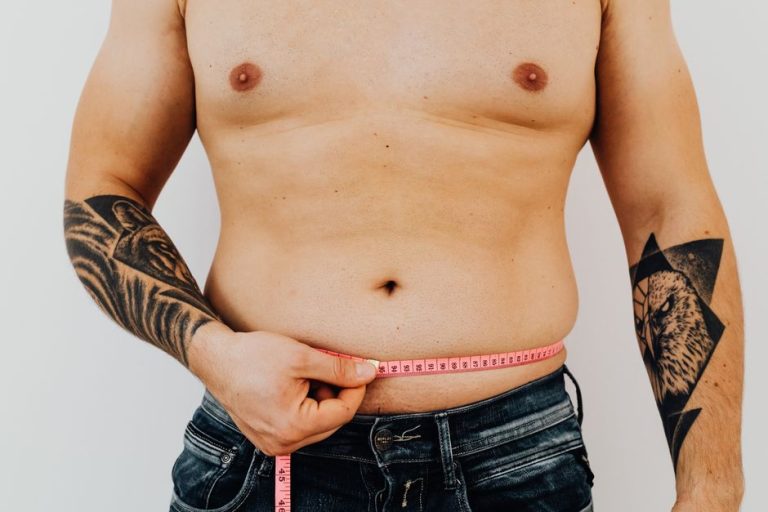
Low testosterone is linked to more body fat, but the stronger effect usually runs the other way: excess weight lowers testosterone. The relationship goes both directions. Losing weight is associated with higher testosterone, and testosterone treatment does not reliably reduce body weight. Morning labs and an evaluation are the only way to know which is driving your symptoms.
That matters because the fix you choose depends on which problem came first.
The short answer: it is a two-way street
Obesity and low testosterone feed each other, but not equally. A review in Clinical Endocrinology concluded that the effects of obesity on testosterone are more substantial than the effects of testosterone on body fat (Grossmann, 2018).
Cleveland Clinic lists increased body fat and decreased muscle strength and mass among the symptoms of low testosterone in men. It also notes that most men with low testosterone symptoms do not have a problem with their testicles or pituitary gland. More often, the issue comes from obesity or diabetes.
How extra weight lowers testosterone
Excess body fat lowers testosterone through two routes. Which one applies depends partly on how much extra weight is involved.
- With modest obesity, low total testosterone mainly reflects lower levels of sex hormone-binding globulin (SHBG), the protein that carries testosterone in the blood (Grossmann, 2018). Free testosterone may be less affected, which is why your provider may look at more than one number.
- With more marked obesity, the brain’s signals to the testes can be genuinely suppressed, likely through inflammation and altered leptin signaling, and made worse by related conditions.
The American Urological Association (AUA) guideline cites data that men with obesity are almost five times more likely to have low testosterone than men without obesity (AUA, Testosterone Deficiency Guideline).
Does low testosterone cause belly fat?
Low testosterone is associated with more body fat, but it is rarely the whole story behind belly fat. Diet, activity, sleep, age, medications and conditions such as diabetes all play a part.
What the trials do show is that testosterone affects body composition more than body weight. In randomized trials, testosterone treatment did not reduce body weight, though it modestly reduced fat mass and increased muscle mass (Grossmann, 2018). The same review concluded that testosterone cannot be routinely recommended for men whose low testosterone is related to obesity, and that weight loss and treating related conditions remain first-line.
Why losing weight can raise testosterone
Weight loss is consistently associated with higher testosterone, and more weight lost means a bigger rise. This is one of the more encouraging findings in the research.
A meta-analysis of 24 studies found that both low-calorie diets and bariatric surgery were associated with significant increases in testosterone (Corona et al., Eur J Endocrinol, 2013). Key findings:
- The amount of weight lost was the best predictor of how much testosterone rose.
- Bariatric surgery produced larger increases than a low-calorie diet.
- The rise was greater in younger men, men without diabetes, and men with more obesity at the start.
The AUA guideline cites the American Association of Clinical Endocrinology’s view that meaningful testosterone improvements generally do not occur until a man loses 5% to 10% of his body weight. The AUA also recommends that all men with testosterone deficiency be counseled on lifestyle changes as part of treatment.
When testosterone testing makes sense
Testing makes sense when you have symptoms, and it needs to be done correctly to mean anything. One random reading is not a diagnosis.
The Endocrine Society guideline and the AUA guideline agree on the basics:
- Diagnose low testosterone only when there are symptoms plus consistently low levels.
- Test total testosterone in the morning, and repeat it on a separate occasion to confirm.
- The AUA uses below 300 ng/dL as a reasonable cutoff.
- When total testosterone is borderline or SHBG may be abnormal, as with obesity, free testosterone can help.
MedlinePlus notes that blood is usually drawn between 7 and 10 a.m., when levels are typically highest. The AUA also advises that men with a BMI of 30 or more, or a waist over 40 inches, have their testosterone checked.
For more on symptoms and testing, see our low testosterone page.
Where TRT and GLP-1 care each fit
They solve different problems, and at Hormone Balance Centers they are separate services with separate evaluations.
- Testosterone replacement therapy (TRT) is for men with symptoms and confirmed low testosterone, after a discussion of benefits and risks. It is not a weight loss treatment. The Endocrine Society recommends against starting it in men planning fertility in the near term, among other conditions.
- GLP-1 weight management with semaglutide or tirzepatide is for eligible adults whose goal is weight loss. Because weight loss is associated with higher testosterone, addressing weight first may be part of the picture for some men with borderline levels.
Your provider looks at your symptoms, labs and goals to decide which, if either, fits. Neither is automatic.
What an appointment at Hormone Balance Centers looks like
Hormone Balance Centers is a telehealth practice for eligible adults in Utah and Idaho, with secure video visits and evening appointments available.
- Call or text 385-361-8549.
- Labs. Your provider decides which tests are appropriate.
- Meet online with Adam Russell, PA-C, a board-certified Physician Assistant with experience in endocrinology and internal medicine, to review symptoms, history, labs, risks and goals.
- A plan. If treatment is appropriate, you get an individualized care and monitoring plan, with ongoing monitoring.
TRT is $750 for the first year for patients new to TRT, or $400 per year for patients transferring existing prescribed care. Testosterone medication is $80 for a 90-day supply through Brighton Compounding Pharmacy, a separate business, billed separately. There is no monthly membership. GLP-1 care is $69 per month or $750 per year, with medication billed separately. Care is self-pay, with documentation available for possible out-of-network reimbursement.
Frequently asked questions
Will TRT help me lose weight?
Not reliably. In randomized trials, testosterone treatment did not reduce body weight, though it modestly reduced fat mass and increased muscle mass. TRT is meant for men with symptoms and confirmed low testosterone, not as a weight loss treatment.
Can losing weight raise my testosterone?
Often, yes. A meta-analysis found weight loss was associated with higher testosterone, and the amount of weight lost was the best predictor of the rise. Guidance cited by the AUA suggests meaningful improvement generally takes losing 5% to 10% of body weight.
Why is my total testosterone low but free testosterone normal?
That pattern is common with extra weight, because obesity lowers SHBG, the protein that carries testosterone. Total testosterone can read low while free testosterone is less affected. Your provider may order a free testosterone test to sort this out.
Should I get tested if I have gained weight?
If you also have symptoms such as low libido, fewer morning erections, fatigue or loss of muscle, testing is reasonable. The AUA advises checking testosterone in men with a BMI of 30 or more. Testing should be done in the morning and repeated to confirm.
Find out what is actually going on
Weight and testosterone are connected, and the right first step depends on your labs and goals. Call or text 385-361-8549, learn about low testosterone and GLP-1 weight management, or get started online.
Sources
- Grossmann M. Hypogonadism and male obesity: Focus on unresolved questions. Clin Endocrinol (Oxf). 2018;89(1):11-21. https://pubmed.ncbi.nlm.nih.gov/29683196/
- Corona G, et al. Body weight loss reverts obesity-associated hypogonadotropic hypogonadism: a systematic review and meta-analysis. Eur J Endocrinol. 2013;168(6):829-843. https://pubmed.ncbi.nlm.nih.gov/23482592/
- Bhasin S, et al. Testosterone Therapy in Men With Hypogonadism: An Endocrine Society Clinical Practice Guideline. J Clin Endocrinol Metab. 2018;103(5):1715-1744. https://pubmed.ncbi.nlm.nih.gov/29562364/
- American Urological Association. Evaluation and Management of Testosterone Deficiency (AUA Guideline). https://www.auanet.org/guidelines-and-quality/guidelines/testosterone-deficiency-guideline
- Cleveland Clinic. Low Testosterone (Low T): Hypogonadism, Symptoms and Treatment. https://my.clevelandclinic.org/health/diseases/15603-low-testosterone-male-hypogonadism
- MedlinePlus. Testosterone Levels Test. https://medlineplus.gov/lab-tests/testosterone-levels-test/